

 Under NDA
Automated Underwriting System (AUS)
Upfront AUS is Prudent AI’s pre underwriting platform for Non QM lenders. It evaluates a loan against lender and investor rules before the file reaches underwriting, giving brokers earlier clarity on whether a scenario can move forward.
I worked on the decision journey connecting the loan application, eligibility analysis, supporting documents and final findings. The goal was to make each stage build confidence in the next.
The experience followed a simple progression: establish the facts, evaluate eligibility, prove the decision and explain the findings.
- Company
- Prudent AI
- Product
- Upfront AUS
- Role
- Principal Product Designer
- Scope
- Product thinking (Mortgage Tech), UX, interaction design and UI system
- Timeline
- 2025 to 2026
The challenge
Non QM eligibility depends on connected information across the borrower, property, credit, income, liabilities, program rules and supporting evidence.
A loan may meet the LTV requirement but fall below the minimum DSCR. A value entered by the broker may conflict with a verified document. Evidence may be missing, expired or rejected.
The product needed to answer four questions clearly:
1. What does the system know about this loan?
2. Is it eligible for the selected program?
3. What evidence is still required?
4. Why did the system reach this decision?
The challenge was turning underwriting logic into a sequence brokers could understand and act on without asking them to interpret a rulebook.
01 / 01
Creating the product structure
I organised the flow around how certainty develops during pre underwriting:
Application overview → Eligibility summary → Initial submission requirements → Findings report
The application establishes the facts. Eligibility evaluates them against the selected program. Submission gathers the evidence needed to support the decision. Findings preserve the reasoning in a form that can be reviewed and shared.
Each stage has a different job, but all four carry the same loan context forward.
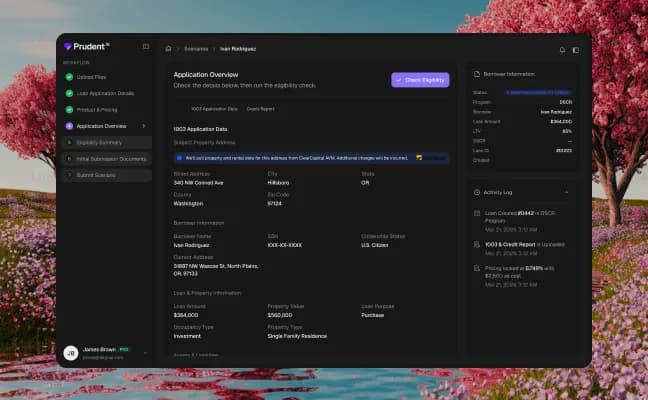
Application overview
The Application Overview brings borrower information, loan and property details, assets, liabilities, credit data and the selected program into one reviewable space.
Clear information groups help brokers verify the scenario without returning to the original application. A persistent summary keeps essential details such as program, loan amount, LTV, DSCR and borrower visible throughout the workflow.
This stage is deliberately factual. It confirms what the system will use before those inputs become an eligibility decision.
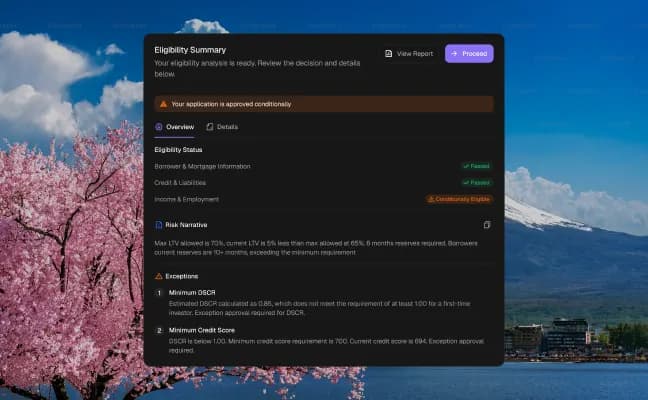
Eligibility summary
The Eligibility Summary explains how the scenario performs against the selected program.
Instead of reducing the result to eligible or ineligible, it shows the conditions influencing the decision. LTV, reserves, DSCR and credit requirements can pass, fail or require an exception.
Every outcome is connected to a reason. A passing condition confirms why the guideline is met. An exception shows the required threshold, the current value and what approval is needed.
The broker can understand the decision before collecting more evidence or discussing the scenario with the borrower.
01 / 01
Initial submission requirements
Once eligibility is understood, the product needs evidence to support it.
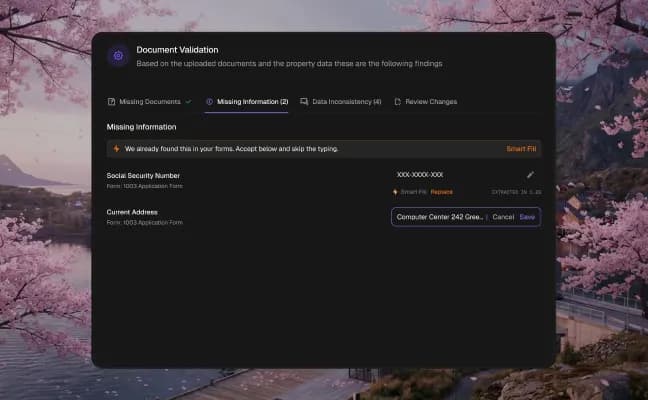
Brokers may receive a complete package as one PDF or collect documents individually. I designed both paths to feed into the same validation model. The system analyses the upload, identifies the documents and maps them to the scenario’s requirements.
The experience then shifts from file upload to submission readiness. Each requirement is marked as received, pending, expired, rejected or duplicated. Progress and summary counts expose what remains unresolved.
Exceptions include a recovery path. Missing evidence can be uploaded, rejected documents replaced and duplicates reviewed. The loan can be registered only when the minimum requirements are met, making readiness a visible product state rather than a judgement the broker makes alone.
Findings report
The Findings Report brings the scenario, evidence and underwriting logic together in one reviewable output.
It separates basic loan information from critical findings and detailed observations. The report can confirm what meets the program, surface exceptions such as DSCR or credit falling below a threshold and identify discrepancies between sources.
The language is designed for action. Instead of saying a value is incorrect, the report explains which sources disagree and what must be confirmed. Instead of displaying an unexplained score, it connects the value to the relevant requirement.
The broker and lender can understand not only the outcome, but the reasoning behind it.
Designing the experience
The product contains a large amount of information, so the most important design decision was often what to show first.
Every stage was organised around one question:
What decision does the broker need to make here?
In the application, it is whether the facts are correct. In eligibility, whether the scenario can proceed. In submission, what evidence must be resolved. In the report, how the conclusion should be understood and acted on.
I developed repeated patterns for navigation, loan summaries, findings, document states, alerts, progress and gated actions through Prudent UI. This gave the entire journey one consistent interaction language, especially while AI work moved between pending, completed and blocked states.
01 / 01
The outcome
The work created a connected pre underwriting experience where each stage increased the quality of the decision.
Loan information became reviewable context. Eligibility became explainable rather than binary. Documents became evidence rather than attachments. Findings became a clear account of what passed, what required attention and why.
The structure can be expressed simply:
Facts establish the scenario. Rules evaluate it. Evidence supports it. Findings explain it.
This supports Prudent AI’s broader promise of moving underwriting clarity earlier in the Non QM workflow without presenting company level outcomes as metrics from this specific design.
What I learned
Trust in an AI product does not come from presenting a confident answer. It comes from making the path to that answer visible.
For Upfront AUS, that meant preserving context, explaining how requirements were evaluated and giving every exception a consequence and a next action.
Automation feels reliable when people can see the facts, reasoning and recovery behind the result.
If I continued the work, I would test the flow across a wider range of incomplete and contradictory loan files, then measure whether it reduces avoidable resubmissions and manual clarification before underwriting.
Thank you for taking the time to review my work.